Medinah Country Club
In Medinah, Illinois, Medinah Country Club's clubhouse is about 120,000 sq ft of Moorish Revival. Richard G. Schmid (MIT) worked under H.H. Richardson and designed the house opened Sep 26, 1926: a dome, a sixty-foot rotunda, and a Gustav A. Brand mosaic. He also designed Chicago's Medinah Temple.

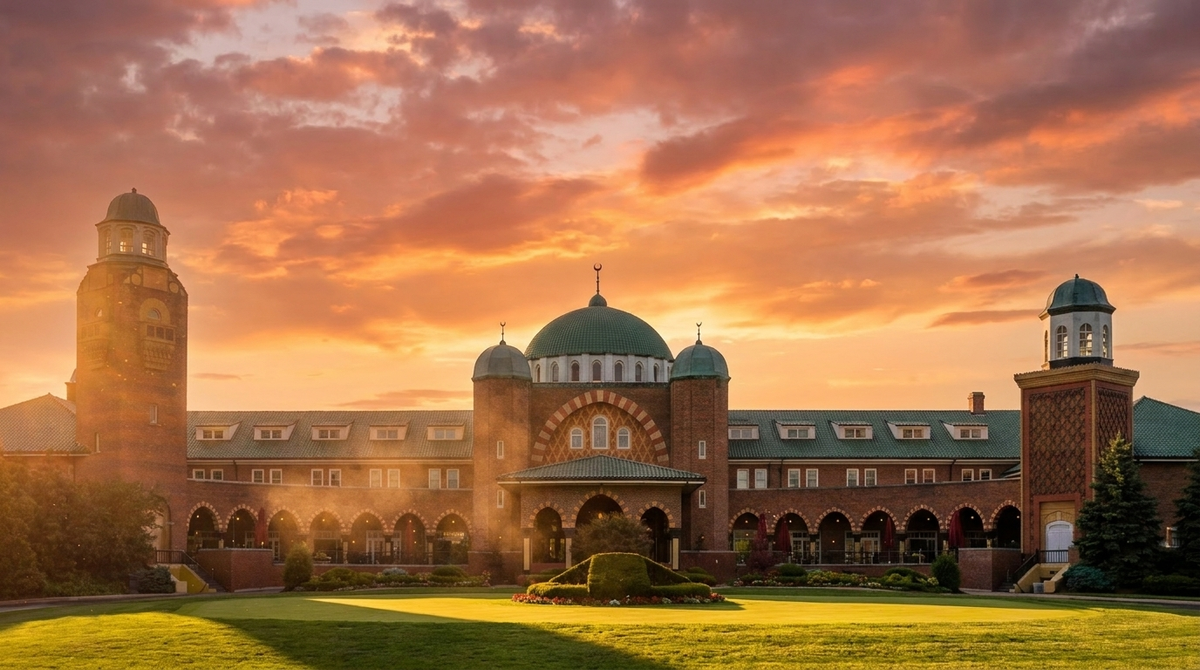
Medinah Country Club's 120,000-square-foot clubhouse was designed in the 1920s by Richard G. Schmid, a charter club member who trained at MIT and worked under Henry Hobson Richardson before spending decades designing Moorish Revival temples for the Shriners across the Midwest.
Schmid was the same architect behind Chicago's Medinah Temple on Wabash Avenue, a Chicago Landmark now operating as a temporary Bally's casino. When the Medinah Shriners decided to build a country retreat on 640 acres of rolling farmland west of the city in 1924, they hired their own man. Schmid delivered a building unlike anything else in American golf: a 120,000-square-foot clubhouse blending Byzantine, Oriental, Louis XIV, and Italian influences under a dome modeled after the mosques of its namesake city, Medina, Saudi Arabia. The interior is anchored by a sixty-foot rotunda with a hand-painted mosaic ceiling, the work of Gustav A. Brand, a German-born artist and fellow club member who had also painted the Chicago temple. The grand ballroom features hand-painted murals that rival a Florentine cathedral.
Best Clubhouse's tour of Medinah Country Club's clubhouseMed

Charles Schwab is offering new clients up to $1,000 when they open an account and transfer a qualifying amount of cash or equities. Click here to claim your new account reward!
Key Details
- Club: Medinah Country Club
- Location: Medinah, Illinois (Chicago suburbs)
- Clubhouse Architect: Richard G. Schmid
- Year Built: 1926 (formal opening September 26, 1926)
- Architectural Style: Moorish Revival
- Notable Features: 120,000-square-foot clubhouse with a sixty-foot rotunda featuring a hand-painted mosaic ceiling by artist Gustav A. Brand; grand ballroom with hand-painted murals; Byzantine, Oriental, Louis XIV, and Italian architectural influences blended in the tradition of Masonic structures; dome inspired by the mosques of Medina, Saudi Arabia; third-floor rooms originally built as a hotel for visiting Shriners, later converted to meeting spaces during a 1997 renovation by Williams Architects; the same architect, Richard G. Schmid, designed Chicago's Medinah Temple (1912), now a Chicago Landmark. Unlike the Tudor Revival restraint of Baltusrol or the Scottish farmhouse austerity of Oakmont, Medinah's clubhouse is an act of pure spectacle, a building designed to overwhelm.

J. Campoli & Sons, Northern New Jersey's premier luxury general contractor, has delivered high-end residential and commercial construction in Bergen County since 1946. We have provided three generations of craftsmanship for clients who don't compromise. Learn more.
Richard Gustav Schmid (1863-1937) was born in Chicago, the son of Robert Schmid, one of the city's pioneering German immigrant architects. After training as a draftsman in the office of Edward Baumann, Schmid studied architecture at MIT, then secured a position with Henry Hobson Richardson in Boston. Richardson died shortly after, but Schmid stayed on with the successor firm, Shepley, Rutan & Coolidge, before spending a year abroad studying architecture in Europe. He returned to Chicago and partnered with Harris W. Huehl, and together they became the go-to architects for Masonic and Shriner organizations across the Midwest. After Huehl's death in 1919, Schmid continued solo and designed the Medinah Country Club clubhouse. Course No. 3 has hosted three U.S. Opens, two PGA Championships, and the 2012 Ryder Cup, site of Europe's "Miracle at Medinah." The Presidents Cup returns to Medinah in September 2026.
View this post on Instagram
Best Clubhouse covers all things golf clubhouse architecture, golf luxury real estate, and golf development. If you're interested in having your golf club renovation, luxury listing, or architectural project featured on Best Clubhouse, see our partnerships page or reach out at contact@bestclubhouse.com.