Myopia Hunt Club
The clubhouse at Myopia Hunt Club was not designed to be a clubhouse. It was built in 1772 as a farmhouse for Colonel Robert Dodge, a Revolutionary War hero who fought at Bunker Hill. The club moved in, and much hasn't changed since.

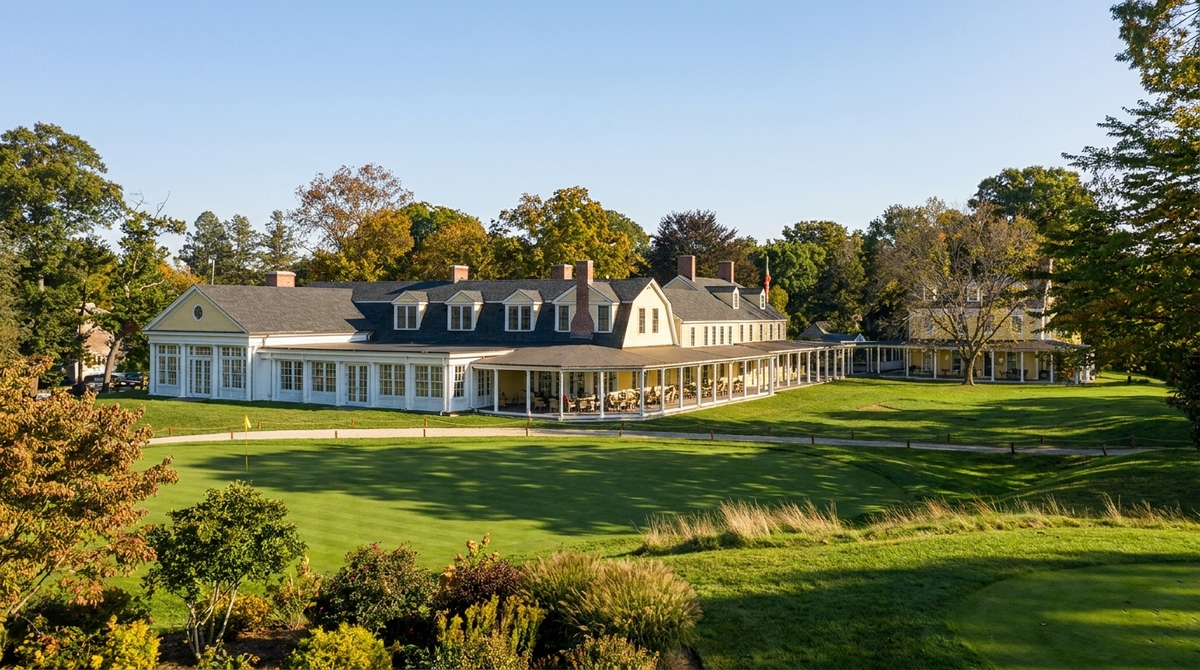
The clubhouse at Myopia Hunt Club was not designed to be a clubhouse. It was built in 1772 as a farmhouse for Colonel Robert Dodge, a Revolutionary War hero who fought at Bunker Hill as a Captain of the Minute Men. The club moved in 110 years later and never left. His sword still hangs over the fireplace.
Best Clubhouse's Tour of the Myopia Hunt Club Clubhouse
Key Details

Charles Schwab is offering new clients up to $1,000 when they open an account and transfer a qualifying amount of cash or equities. Click here to claim your new account reward!
- Club: Myopia Hunt Club
- Location: South Hamilton, Massachusetts
- Clubhouse Architect: None (converted 1772 Colonial farmhouse, built for Colonel Robert Dodge; expanded incrementally by the club from 1882 onward; most recent renovation by Acanthus Architecture)
- Year Built: 1772
- Architectural Style: New England Colonial
- Notable Features: Yellow clapboard exterior with fox weather vane; original creaking hardwood floors; self-service bar with Prohibition-era wooden liquor lockers still in use; enclosed telephone booths in the entry foyer; wrap-around porches connecting the main clubhouse to the Annex (c. 1900); Winthrop Terrace enclosed with Pennsylvania Bluestone floors and a bar set within the original porch columns

J. Campoli & Sons, Northern New Jersey's premier luxury general contractor, has delivered high-end residential and commercial construction in Bergen County since 1946. We have provided three generations of craftsmanship for clients who don't compromise. Learn more.
The Dodge family sold the property in 1866 to John Gibney, a local farmer whose name survives today on Gibney Field, one of the oldest continuously used polo fields in America. The Myopia Fox Hounds leased the land starting in 1882 and purchased it outright around 1891, incorporating as the Myopia Hunt Club in 1892.
As the club grew, so did the building. Dining and banquet rooms were added to the west. A service wing went north. Wrap-around porches connected the main house to the Annex, built around 1900 for the golf locker rooms. The most recent renovation, designed by Acanthus Architecture, created new internal circulation, carved a reception room from the original Dodge living room, and fully enclosed the Winthrop Terrace overlooking the 18th green.
Four U.S. Opens were played here between 1898 and 1908. The 1901 winning score of 331 by Willie Anderson remains the highest in tournament history. President William Howard Taft played his summer golf at Myopia and famously needed help escaping a cross bunker on the 10th hole. That bunker now has stairs.
Fewer than 12,000 rounds are played at Myopia each year. The club still runs the oldest drag hunt in America, and polo is played on Gibney Field every summer, open to the public on Sundays. Nothing about Myopia has been modernized because nothing needs to be.
If you enjoyed this post, be sure to explore our clubhouse profiles of Baltusrol Golf Club, another founding-era American golf institution, and Oakmont Country Club, whose course architect H.C. Fownes was often compared to Myopia's Herbert Leeds for their shared autocratic approach to design.
View this post on Instagram
Best Clubhouse covers all things golf clubhouse architecture, golf luxury real estate, and golf development. If you're interested in having your golf club renovation, luxury listing, or architectural project featured on Best Clubhouse, see our partnerships page or reach out at contact@bestclubhouse.com.